


Barton Farm (now Lower Farm), Barton Village Road

Barton Farm was on the north side of the Bayswater Brook, opposite the bottom (north) end of Barton Lane (now part of Barton Village Road). This lane continued north from the hamlet of Barton down the hill to the brook to provide access to Barton Farm on the left and Wick Farm on the right.
Barton Farm was originally Copyhold of the Manor of Headington, but a Deed of Enfranchisement dated 20 October 1871 contained a release of all Manorial rights.
The map extract on the right drawn in 1898 shows just the field formerly owned by the Oxford Preservation Trust marked as Barton Farm, with the farmhouse in a different field to the west, but it only measured 4 acres, 1 rood, and 36 poles, so obviously the farm included land to the west.
The farm is now called Lower Farm. Although today it is in Beckley & Stowood parish and thus comes under South Oxfordshire District Council, historically it was always part of Headington and became part of the City of Oxford in 1929. Hence its address is Barton Village Road, Headington.
The plan below taken from a 1911 auction catalogue shows that Barton Farm was then given only to the bulk of the land to the west, and the field that had been marked Barton Farm on the 1900 map was now a market garden under the separate ownership of Miss Bridgwater.

The photograph below shows the ancient grass-covered stone bridge over the Bayswater Brook at the bottom of Barton Village Road and the small field that is marked Barton Farm on the above map immediately behind a metal fence. The bridge now leads to a closed fence, but here Google Earth shows traces of a faint path that went up from the bridge and turned left to towards the traces of a building in the field, to the east of the present farmhouse of Lower Farm. At the start of this vanished path is a cluster of stones, including an important boundary stone dated 1684.

This four-acre field was owned by Miss Bridgwater in 1911.
In 1935 Sir Michael Sadler (a founder of the Oxford Preservation Trust who lived at the Rookery in Old Headington) persuaded the Trust to buy it because was concerned at the prospect of building in the valley of the brook near Barton, then a small hamlet of Old Headington but about to be become a council estate.
In October 2022 the Trust announced that they had sold this field. The purchaser was Christ Church, Oxford, which needs this old Barton Farm field for bus access to its proposed development of the green-belt land north of Bayswater Brook.

The small boundary stone dated 1684 (above and right) in the south-east corner of that field was awarded Grade II listed status on 17 April 2023. This marks the original boundary between that field and Wick Farm to the east (see plan from Headington Enclosure Award of 1802–5 below).
Since the bus route proposed by Christ Church & Dorchester Residential Management would have destroyed this stone, on 30 May 2023 they submitted planning application P23/S1832/LB to South Oxfordshire District Council seeking to relocate the stone out of the path of their road.
Owners of Barton Farm
The farm came under the Manor of Headington until 20 October 1871.
Under the Headington Enclosure Award of 1805, Mary Jones was awarded the bulk of the present Lower Farm and Martha Barton (wife of Edward Barton) was awarded the former Oxford Preservation Trust field: see details at the end of this page.
Herbert Parsons (1822–1911), grandson of the Oxford Mayor of the same name, leased Elsfield Manor House from Lord North, and bought out the co-proprietors of Forest Farm, buying the whole estate from the Norths in 1886. It was probably at this time that he also bought Barton Farm (but not the field to the east).
Barton Farm was put up for auction by Parsons' executors in 1911, and may have been bought by Christ Church at this time. That college bought the rest of his Elsfield land in 1919.
The auction of Barton Farm took place at the Roebuck Hotel in Oxford on 24 March 1911, along with New Inn Farm in Beckley and Jones' Ground in Stanton St John. The auction catalogue reveals some useful information about the farm (not including the field to the east):
65 |
Farm house and Homestead |
Buildings &c |
0a 1r 34p |
66 |
Brook Meadow |
Pasture |
5a 1r 1p |
54 |
Upper Brook Meadow |
Pasture |
7a 2r 39p |
55 |
Big Field |
Arable |
24a 1 r 39p |
TOTAL |
37A 3R 33P |
||
The description of Lot 4 was as follows:
The HOMESTEAD comprises a Stone, Brick and Slated Farm House, containing Sitting Room, Kitchen, Scullery, and 3 Bedrooms; Barn, Stable for 4 Horses, Cattle Shed and Loose Box, a range of Piggeries, 2 other Piggeries, and a 4-bay Wagon Shed, all substantially erected.
The foregoing is in the occupation of Mr. Alfred Quelch, a yearly Michaelmas Tenant, at the moderate annual rental of £81 0s. 0d.
The property is free from Land Tax and Tithe Rent Charge.
The Growing Timber on this Lot has been valued at the sum of £68 12s. 6d., and the purchaser will have to pay for same in addition to the purchase money.
The separate nursery land
The owners from 1914 (listed in the 1935 conveyance to the Oxford Preservation Trust) were as follows:
- 22 June 1914: Thomas Frederick Hawkins and Francis Williams conveyed the nursery land to John Theodore Dodd
- 9 June 1920: The nursery land was mortgaged to A. R. Jacobs
- 7 October 1925: A. R. Jacobs and his Mortgagee conveyed the nursery land to Albert Sanders, with Local Charge to Albert Sanders and Mrs E. A. Coombes the following day. This mortgage was transferred to W. T. Harvey on 5 July 1932
- 13 February 1926: Albert Sanders conveyed the nursery land to Ernest William Gurden, with Local Charge to Mrs E. A Coombes on 8 October 1926
- 20 December 1935: Ernest William Gurden conveyed the nursery land to the Oxford Preservation Trust.
Tenants/owners of Barton Farm (later known as Lower Farm)
Robert Bryan/Brian/Bryant (1806–1874) appears to have been the farmer at Barton Farm in the middle of the nineteenth century: he was listed as a market gardener in Barton in the Post Office Directory for 1847, and in the 1851 census as a Barton farmer. In the 1861 census Bryan's Farm was listed as the last dwelling in Barton, immediately after Wick Farm, and was almost certainly Barton Farm: it was then occupied by Robert Bryan (56), described as a farmer of 50 acres employing two men and one boy, and his wife. He is last listed in a directory of 1864.
This advertisement published in Jackson's Oxford Journal on 13 November 1852 shows that Bryan grew swedes, mangel wurzels, turnips, and pea fodder on the land of Barton Farm:

On 1 October 1853 there was announcement of the forthcoming sale at the Black Boy of a rick of well-housed old meadow hay standing in Robert Bryan's rick-yard at Barton.
The 1871 census shows William Wiggins (63), a farmer of 60 acres employing three men and one boy, living at Barton Farmhouse with his wife and son.
At the time of the 1881 census Joseph Sturges (26), a shepherd, was living at Barton Farmhouse with his wife and two children, and Sturges Close in Barton is named after him. The owner, however, appears to have been Edwin Hedges.
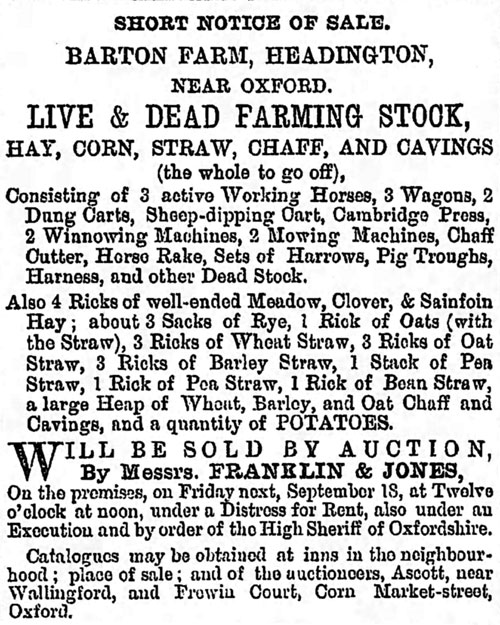
The following notice of sale of live and dead farming stock under a Distress for Rent published in Jackson's Oxford Journal on 12 September 1885 indicates that Barton Farm was a mixed farm, with sheep and pigs as well as crops:
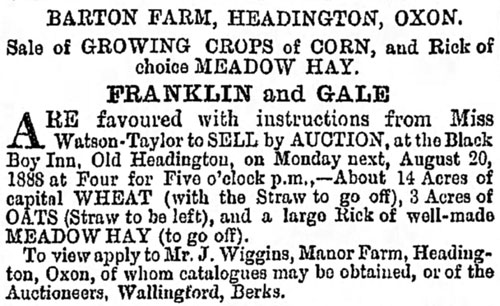
The following advertisement, published in Jackson's Oxford Journal on 18 August 1888, implies that John Wiggins of Manor Farm in Old Headington (which was owned by Miss Isabella Watson-Taylor) was then growing at least 17 acres of crops at Barton Farm:
In the 1891 census Richard Small (38), a carter, is listed at Barton Farmhouse with his wife and five children.
In directories for 1893 to 1899, Alfred Quelch is listed as the farmer at Lower Farm, Barton (the first time this name for the farm in given in a directory). He was also a market gardener, and appears to have had other farms in the Headington area. He is also listed as the tenant of Barton Farm in the auction catalogue of 1911, but after 1900 the farm appears to have been occupied by sub-tenants.
The 1901 census shows Francis Eeley (25), described as a farmer and an employer, living alone at Barton Farmhouse, and he is also listed in Kelly's Directory for 1901 as a farmer in Barton. From 1902 to 1904 Joseph & Francis Eeley were jointly listed as farmers in Barton.
From 1906 to 1916 Mrs Louisa Wheeler is listed in directories as “farmer & dairy” in Barton, and the 1911 census shows her as a 52-year-old widowed farmer on her own account living at Barton Farm, Barton Lane, Headington together with her daughter Louisa Emily Wheeler (23) who looked after the dairy and two male 18-year-old farm assistants. In 1915 and 1916 she was listed as operating from both Barton and Headington: her second farm was probably Laurel Farm, then managed by her son Walter James Wheeler.
In 1915 women had to help the older men with the harvest at Barton Farm as many young men were away at war: photograph.
A map drawn in 1919 still shows the field to the east labelled as Barton Farm.
On 6 June 1920 Margery Mildred Sanders, daughter of Albert Sanders, the farmer at Barton Farm, and his wife Mildred, was baptised at All Saints’ Church, Headington. followed by their son Albert John Sanders on 27 September 1923. At this point Sanders was renting the field to the east, but he owned it briefly in 1925/6. It appears that members of the Sanders family may have continued to live in the farmhouse after 1926, as Annie Sanders (38), a dressmaker, and Frederick Conway (35), a railway inspector, both gave their address as Lower Barton Farm when on 15 August 1927 they were married at St Andrew’s Church.
From 1935 to 1943 there is a listing in directories for:
- Barwick Nurseries (Ernest William Gurden) relating to the Oxford Preservation Trust field
- Lower Farm to the west (with Walter Haynes listed as the farmer).
This map drawn in 1937 shows an access road leading into the separate nurseries opposite the end of Barton Village Road.
The 1939 Register shows Walter G. Haynes (born in Marston in 1878), described as a dairy and poultry farmer, living at Lower Farm, Barton with his wife Margaret and their son Stanley Walter Haynes (born in Marston in 1905), who was described as a cowman). It seems likely that after 1945 he also rented the nursery land to the east, as thereafter it has no separate listing. He continued to be listed the farmer at Lower Farm until the last Kelly's Directory in 1976.
By 1980 Lower Farm had been taken over by his son Stanley Walter Haynes, The latter died in 1995, and the farm is currently owned and occupied by his son Graham Anthony Haynes.
The sale of the field to the east (1) to the Oxford Preservation Trust in 1935
and (2) to Christ Church, Oxford in 2002
By 1926 the four-acre field labelled on maps as Barton Farm was known as Barwick Nurseries (presumably a contraction of Barton and Wick). It was described as follows when it was conveyed to Oxford Preservation Trust by Ernest William Gurden in 1935:
All that piece of land situate at Barton in the Parish of Headington in the City (formerly County of Oxford containing Four acres one rood and thirtysix poles or thereabouts and Numbered 64 on the Ordnance Survey map (Edition of 1921) for the said Parish All which said hereditaments are now known as Barwick Nurseries Barton aforesaid
It is clear that none of the land surrounding this field had the same owner, as it is stated that: “The fence on the South (facing the road) and the lower part of the fence on the East belonging to the Vendor. The remainder of the fence belonging to the adjacent owners”.
The purchase in 1935 by the Oxford Preservation Trust of the Barwick Nurseries (formerly known as Barton Farm) was made at the instigation of Sir Michael Sadler, a founder of the Trust who lived at the Rookery in Old Headington. He was concerned at the prospect of building in the valley of the brook near Barton, a small hamlet of Old Headington that was about to be become a council estate. This field was then Charity Commission Enrolment No. 29/36.
On 19 March 1936 the Oxford Preservation Trust entered into an agreement to rent this land out to the former owner at £24 per annum, and hence the nursery of E. W. Gurden & Son continued to be listed in directories up to 1943. (Gurden, born in 1881, lived at 2 Woodbine Cottages at the top of Headington Hill from at least 1924 until his death in early 1963.)
The present owner of Lower Farm states that it was then farmed and used as a market garden by a Mr Jeffrey, but he is not listed in Kelly's Directory.
From the mid-1950s to the present the field has been rented by the owner of Lower Farm.
In August 2022 the Oxford Preservation Trust sold this field to Thomas Wolsey Property Ltd (Christ Church), who are planning to develop the land to the north of the Bayswater Brook. The Trust made the following announcement in October 2022:
These four and a half acres were bought by OPT in the early 1930s to secure the views across from Old Headington. At the time Barton was still a rural hamlet and the ring road was only just being built. Today, with the development of the original Barton estate, and then Barton Park, now added to by changes to the Green Belt, which OPT opposed, and the proposed Bayswater Brook, the land will be surrounded on all sides. The land can no longer keep its rural character or share its views, so that OPT, after long and careful thought, has agreed to it becoming part of the wider development where it can be better managed. Covenants will control its use, ensure it has public benefit, and that no buildings can be built upon it.
The Oxford Preservation Trust explains here about their sale of this field and the use of the money raised to buy a ten-acre field at Harcourt Hill.
Available material on Barton Farm
Weston Library:
- Auction catalogue, Barton Farm, 24 May 1911: G.A, Oxon b. 90 (10)
Oxfordshire History Centre:
- 1915: Photograph of harvesting at Barton Farm on 8 September 1915 (POX0140058)
and of women and children loading a hay wagon (front-page image in the Oxford Journal Illustrated of 8 September 1915, POX0050016).
No preview of either is available - 1935: Purchase of Barwick Nurseries (the eastern field of Barton Farm) by the Oxford Preservation Trust:
O21/4/D12 (four documents) - 1936: Agreement between Oxford Preservation Trust and Ernest William Gurden for the latter to rent Barwick Nurseries for £24 a year: O21/4/D26/21
Note that the items relating to “Barton Farm” listed by the Centre as held in the Town Hall archives relate to a different farm in Barton (at the top of Barton Village Road opposite Barton Manor)
Barton Farm in the Headington Enclosure Award of 1802–1805Note that its boundary with Wick Farm is further west than today  Plot 93: the part of the present Lower Farm adjoining the former Oxford Preservation Trust field Plot 95: the south end of the former Oxford Preservation Trust field: * The land surveyor Edward Barton had moved to Headington with his wife Martha Barton née Godfrey by 10 June 1781, the day that their son William Barton was baptised at St Andrew's Church, and in 1796 they were living at Church House in St Andrew's Road. Barton was appointed one of the three Commissioners in charge of dealing with the enclosure of Headington, and he himself was awarded three plots (Nos. 94, 97, & 98) and his wife Martha two (Nos. 56 & 95). He died intestate at Headington at the age of 57 on 29 July 1804. |
