


Rock Edge (Crossroads Quarry)
 The clay layer has eroded back, so the limestone layer above juts out
The quarry at Rock Edge is a Site of Special Scientific Interest (SSSI). It is situated at the south-east end of Windmill Road in Headington (map).
It was formerly known as the Crossroads Pit, as it stood at the important junction where Old Road (the main route to London until the late eighteenth century) crossed the road leading between the villages of Cowley and Old Headington. This is probably the quarry that was on Magdalen land near the windmill from which Cardinal Wolsey acquired the stone for Cardinal College (now Christ Church) in the 1520s.
- Geological Conservation Review: Cross Roads Quarry
- Stone in Archaeology Database: Cross Road Quarry, Headington and Windmill Quarry, Headington
- Oxford Geology Trust leaflet about Rock Edge
The two map extracts below dated 1876 and 1939 show the development of housing around the old quarry.


The “New Headington and Headington Stone Quarry” belonging to Messrs. George and John Snow that was advertised for sale by auction in Jackson's Oxford Journal on 21 June 1856 is likely to be this pit, as no other quarries were in the New Headington area. The 1851 census shows John Snow (54) living with his unmarried son George Snow (27) in Headington Quarry: both were described as masons.
Houses were built in the road called Rock Edge in the mid-1930s, and a municipal restaurant opened on the grass at the top during the Second World War.
Geology of Rock Edge
The cliff of the pit at Rock Edge has exposures of Upper Jurassic limestone, laid down about 160 million years ago. This pit is thought to have been a former boundary between a coral reef and the surrounding shallow sea, and there are many fragments of coral and fossils including sea urchins.
South end of the exposure (closer Old Road): The limestone here is Coral Rag, made up of coarse fragments that broke off the reef: it is very rubbly and contains many coral and shell fossils.
North end of the exposure (closest to York Road): The limestone here is Wheatley limestone, made up of material that washed off the reef, and the fossils are smaller and more fragmented.
Two pictures of the Rock Edge pit taken by the British Geological Survey in 1915:
P252731 and P252732

Right A fine coral head at Rock Edge. Coral heads consist of accumulations of individual animals called polyps, arranged in diverse shapes. The coral reef at Headington would have been a patch reef, which is comparatively small reef outcrop
Below: Isastraea coral at Rock Edge

Other corals to be found at Rock Edge include Thamnastria, Thecosmilia, and pecten shells (scallops).
Friends of Lye Valley and the conservation of Rock Edge
The Friends of Lye Valley work with Oxford City Council in the management of Rock Edge, and run joint conservation work parties and family fossil events in conjunction with the Oxfordshire Geology Trust:
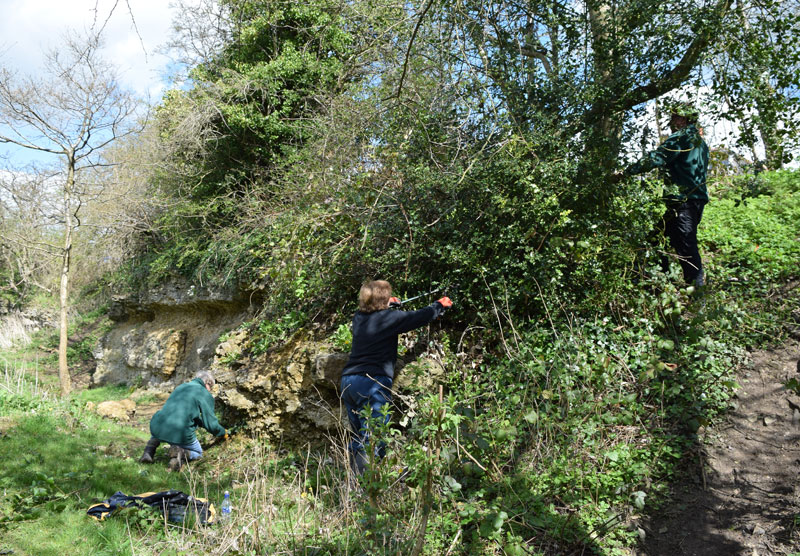
The Friends of Lye Valley also seed the grass at the top with wild flowers.
