The Britannia Inn
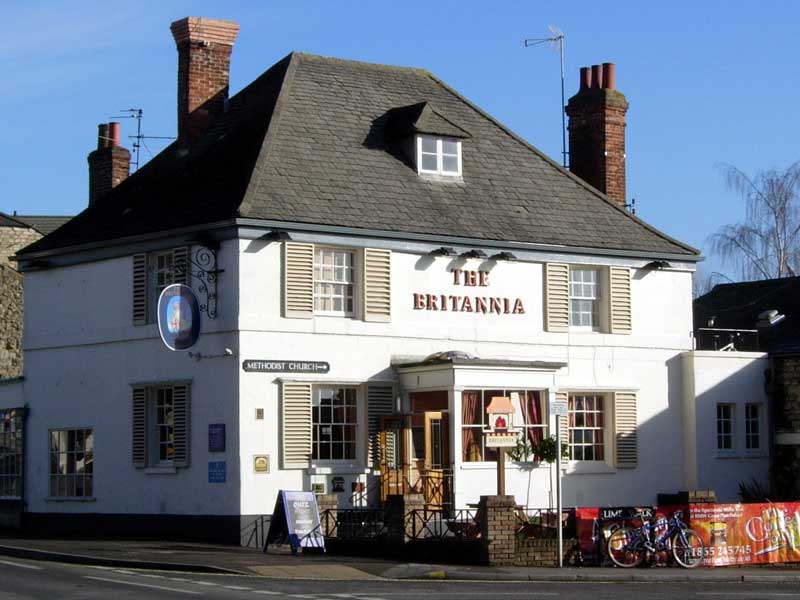
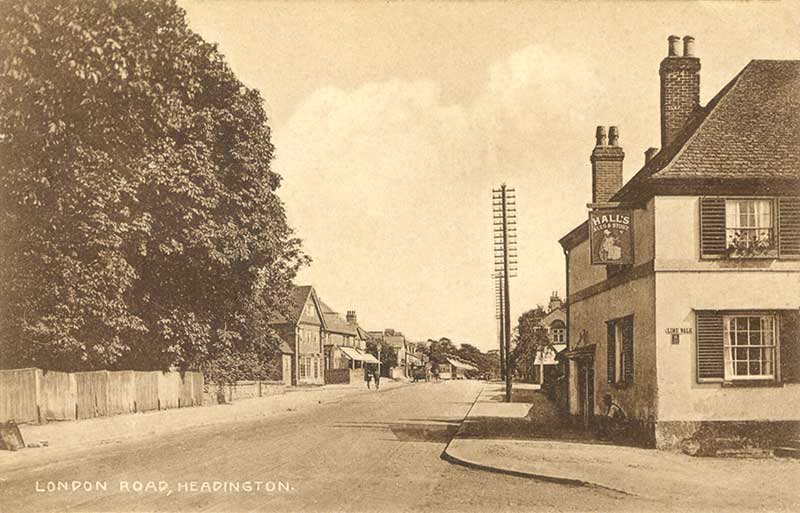
The Britannia Inn on the corner of Lime Walk and London Road was built around the time that the new London Road was cut through the fields of Headington in the 1770s (making Headington’s former coaching inn, Titup Hall on the Old London Road, quite redundant).
The inn is shown on Davis’s 1797 map of Headington (based on a survey of 1793–4) as the White House, but it was the Britannia by 1805. The Headington Enclosure Award of that year describes it as a mere pub in this description of Osler Road: “one other public Carriage Road and Driftway … branching out of the said new Turnpike Road near to a certain public House called the Britannia”. It is however shown as the Britannia Inn on Bryant’s 1824 map.
Under the 1805 Enclosure Award, the inn together with its field for stabling the coach horses (Plot 26) was awarded to William Mott. Its land then measured 8 acres 3 roods and 14 perches, and included the area now occupied by the top end of Lime Walk to the south, and the Mount Pleasant Hotel to the east.
When horses were being changed here, doubtless passengers would have taken meals at the Britannia, and those on a journey to places like Worcester may well have stayed here. (People whose destination was Oxford itself were more likely to sleep at the Angel or Greyhound Hotel in the High Street, or the Star (Clarendon) in Cornmarket.)
The diaries of Mary Latimer of Headington House that cover the years 1817–1824 give a good picture of the London coaches stopping at Headington, and she mentions three: the Blenheim, the Angel, and the Star. Many friends of her family broke a long journey by staying overnight at Headington House, which then conveniently had a lodge on the London Road overlooking the Britannia, including her brothers’ young companions on their way to and from boarding school.
Horses were evidently changed at the Britannia, because on 18 December 1817 Mary writes: “Mrs Cooper and Miss Ricketts from Charlton took a luncheon, on their road to London, but only remained while the Coach horses were changed.” The other passengers would doubtless have taken their luncheon at the Britannia itself.
It is evident from Mary Latimer’s diaries that the Star Coach, which travelled from London to Cornmarket via the Britannia, was also used by the Headington gentry for short trips to and from central Oxford.
The Britannia coaches also feature extensively in the later diaries of 1830–1836 written by Mary’s mother Eliza. She mentions nine coaches that picked up and dropped off passengers in Headington (presumably at the Britannia): there were the Blenheim and the Star as before, plus the Champion, Union, Regulator, King William, Alert, Wonder, and a very fast coach called the Age. There is an interesting vignette of Eliza Latimer’s husband Edward waiting in vain at the Britannia on 6 September 1831: “Mr L intended setting off for London & Dover by the King William Coach, but owing to the approaching Coronation the coaches were all full, and after waiting till past one he set off in his gig with the coachman for Wycomb, from whence he proceeded in a chaise to London.”
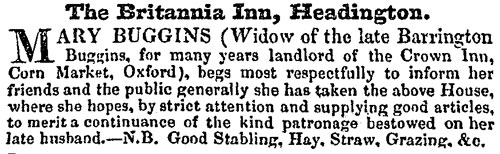
On 6 February 1830 Thomas Mott, son of William and owner of the inn, died: he was described as a “brewer, maltster, and farmer”. The inn was held by his Trustees, Thomas Knowles and William Parsons, who in 1836 put up for sale the land now occupied by Mount Pleasant and then seven years later sold the inn itself, inserting the following advertisement in Jackson’s Oxford Journal for 7 October 1843:

It appears that the Britannia was bought by Hall’s: the Headington Rate Book for 1850 shows that the inn was then owned by the brewer Henry Hall & Co and occupied by Richard Lindars, and its land (now the top part of Lime Walk) comprised four acres and two roods, with a rateable value of £32 and a gross estimated rental of £38 4s. This was only half the size it had been in 1805.
The development of the railway spelt the end of coaching. Even as early as 1841, the census shows only one guest staying overnight at the Britannia: the wood engraver Henry Burrows, who would recently have arrived in Headington to join Orlando Jewitt. Similarly at the time of the 1851 census only one person, a dealer in silk goods, was staying at the inn.
In 1861 there were just two guests (and a live-in ostler) at the Britannia. By 1871 there were no guests, and the innkeeper was supplementing trade by operating as a fly proprietor from the inn. No landlords stayed for long during this period of decline (see table below).
The Headington Benefit Society was based here from 1856 to 1871.
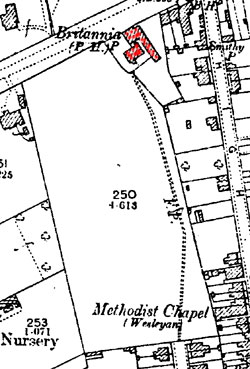
The Britannia Field (shown on the left in 1899) occupied the area now covered by the houses at the north of Lime Walk. By 1902 the days of the coaching inn were over and few horses needed stabling, and in that year the Britannia let out its field to Headington (later Oxford) United.
An old stable building still stands to the south of the inn.
In 1910 Dring the carrier started his horse-drawn coach service from Windmill Road to Oxford, and this may have been the final nail in the coffin of the coaching side of the Britannia, whose field was sold in 1914 for the development of the north end of Lime Walk.
The 1911 census shows Harry George Watts (41) as the licensed victualler here, living with his wife Annie (48). They had been married twenty years but had no children, and they had two nephews living with them: William Jennings (29), a cowman employed by Mrs Newall of White Lodge, and Albert Edward Jennings (8). Watts was still here in 1921, with Annie, now described as his assistant in the business, and their nephew (Albert) Edward Jennings (19), a motor engineer for William Morris in Holywell Street. Also living with them was Francis Wicks (72), described as a servant who offered general help at the inn.
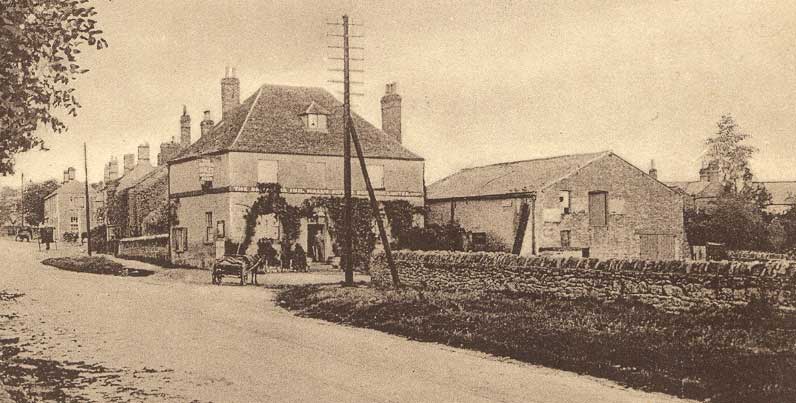
The postcard below shows the Britannia in about 1940. A photograph of the pub in 1957 can be seen here.
The building was completely refurbished in mid–2003 and is now part of the Mitchells & Butlers Ember Inn chain.
In December 2023 Mitchells & Butlers submitted a planning application to strengthen and repair the stone barn at the Britannia, plus other work in the pub and garden:
Postcard showing the Britannia in c.1905
Some landlords of the Britannia |
|
1805 |
William Mott (Landlord in 1805) Thomas Mott (Landlord to 1830) |
By 1821 |
(1) Robert Miles (Landlord to 1821) (2) Mrs Ann Miles, his widow (Landlady 1821–1829) (3) Thomas Phelp, second husband of Mrs Miles (Landlord 1829–1837) (4) Mrs Mary Ann[e] Phelp (Landlord 1841–1847) |
1847–1849
|
Mrs Buggins. Jackson’s Oxford Journal of 28 October 1847:
On 7 July 1849 Jackson’s Oxford Journal reported a violent assault at the Britannia on Mrs Mary Buggins and her daughter Martha Buggins. |
1851–1853 |
Richard Lindars |
1854 |
Thomas Godfrey |
1855–1857 |
George Vallis |
1858–1864 |
Robert East |
1867–1872 |
William Tanner |
1872–1876 |
Edward Matthews |
1877 |
Richard Green |
1880 |
Noel Baddeley (aged 30) died here on 13 October 1880 and his wife Rebecca Sarah Baddeley, née Ash (aged 35) two months later on 26 December 1880. They had only been married two years, and were buried in St Andrew's churchyard |
1881–1884 |
James Frayling |
1884–1890 |
Arthur Wild or Wylde |
1891–1902
|
Walter James Taylor At the time of the 1901 census, Walter is living with his parents and his sister Lavinia (31), who is described as a helper in his business as a licensed victualler |
1903 |
John Andrew Stevenson |
1904–1908 |
Walter Meeson |
1909 |
Frederick George Walker |
1910–1925 |
Henry George Watts |
1926–1947 |
Isaac Charles Wyatt |
1952–1956+ |
Reginald S. Colk |