


Headington Lodge (White Lodge & Sandy Lodge), Osler Road

List entry for White Lodge and Sandy Lodge: 1047174
List entry for their boundary wall fronting Osler Road: 1047174
White Lodge in Osler Road (above) is the south wing of the
mansion that was known as Headington Lodge. The main part of the mansion
to the north is now known as Sandy Lodge.
In the late 1700s the brewer Edward Tawney (1735–1800) built a “gentleman’s farmhouse” in the Croft (Osler Road did not exist until 1802). On his death in 1800 he left that farmhouse to his cousin’s daughter, Mrs Ann Wharton (née Tawney), with instructions that it should go to her eldest son Theophilus Wharton after her death. The Headington Enclosure Award map of 1805 shows that Mrs Wharton’s house was on the site of White/Sandy Lodge.
That Enclosure Award granted Theophilus Wharton (1778–1831) all the land to the east of Osler Road as far as the turning into the Croft, excluding the farmhouse owned by his mother:
One Plot of Land or ground numbered 63 containing five acres one rood and twenty eight perches situate in Pound Field bounded on the North by the allotment numbered 63(a) on part of the South East and on the North East by the House and premises of Mrs Wharton on the remaining part of the South East by the allotment numbered 62 [Headington House] on the South by the Road numbered I [London Road] and on the North West by the Road numbered VIII [Osler Road]
Theophilus Wharton eventually inherited his mother’s farmhouse on her death in 1824. Initially, however, he and his younger brother Bryan (1782–1839) continued to live at Wick Farmhouse in Barton, which they had bought in 1813.
Jackson's Oxford Journal of 28 May 1825 describes an alarming fire that broke out at the farm in Old Headington on Saturday 21 May, caused by a lad firing off a gun in the yard, the wadding from which set fire to some straw. The fire spread to the thatch of an adjoining outhouse, and then to the barn and the pigsties, and the farmhouse was at one time in imminent danger. The total loss, which amounted to £700, was covered by insurance. The newspaper report states, “The farm house was at one time in imminent danger, and was only preserved by the active exertions of the persons present. It is a tribute due to many Gentlemen of the University and others to state their exertions on the occasion were unceasing; we wish we could say as much of some of the lower orders, who seemed more intent on looking after liquor than assisting in extinguishing the flames.”
On 2 July 1829 at St Andrew's Church, Pershore, Worcester, Brian Wharton married Catharine Grape (the sister of Mary Grape who had married the current Lord of the Manor of Headington, Thomas Henry Whorwood, in 1807).
Theophilus Wharton died at the age of 52 on 21 October 1831. His brother Brian did not remain long at Wick Farm, which he believed it was haunted, and just a month later on 26 November 1831 an auction of his furniture there was advertised in Jackson's Oxford Journal.
It was probably at this point that he converted his mother's farmhouse in Old Headington into the regency villa it is today. It was originally known as Headington Lodge, and its main entrance was in Osler Road, where its own little lodge (or gatehouse) still stands..
Brian Wharton died in Headington at the age of 57 in August 1839 and was buried at St Andrew's Church. His widow Catharine returned to Worcestershire.
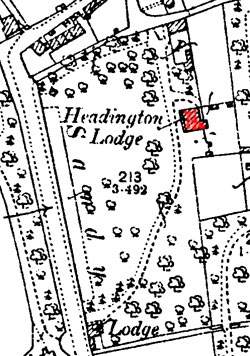
Right: This detail from the 1899 map of Headington shows Headington Lodge, with its garden stretching from the Croft to the north and Cuckoo Lane to the south. Its western boundary is Osler Road, and to the east is its next-door neighbour, Headington House.
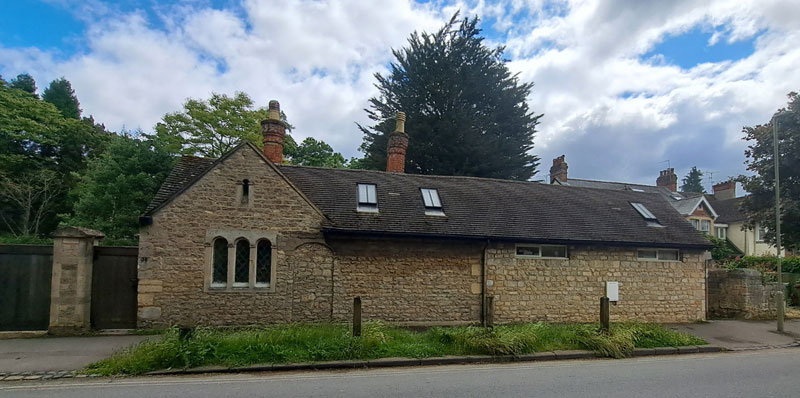
That map shows the lodge house of Headington Lodge in the south-west corner of the garden, adjacent to Cuckoo Lane. When the newer house called Greenways was built towards the south end of the garden, the lodge house was cut off from the main house and became a separate dwelling, now numbered 38 Osler Road (below).
Theophilus Wharton left Headington Lodge to his nephew Mark Theophilus Morrell. At the time of the 1841 census Morrell was not at home, and “M T Morrell's Headington House” was occupied only by his servant Thomas Frogley and his family. Morrell died in Headington at the age of 29 early in 1842, and the house then passed to his cousin, Charles Tawney (1780–1853), who was a partner in the Hall & Tawney Brewery and had been Mayor of Oxford in 1837 and 1840. His town home was Brewery House in Paradise Street, Oxford, but he must have used this house as his country retreat, as the Headington Rent-Book for December 1850 shows him as both owner and occupier at this time. Its rateable value was then £58.5s.0d, and its estimated extent just over 5 acres.
Charles Tawney died in 1853 and his wife in 1854, and their children, Henry Copland Tawney and Mrs Elizabeth Copland Fisher (husband of the surgeon Thomas Richard Fisher) inherited the house.
Between 1861 and 1902 Headington Lodge was let out to various people: Mrs Williams was there in 1861 and the Misses Hillderson in 1862–3. Jackson's Oxford Journal of 13 July 1867 advertised three horses for sale here as the owners were going abroad. John Martin, a retired storekeeper from Portsmouth Dockyard, was living in Headington Lodge at the time of the 1871 census.
The following advertisement for the letting of the house appeared in Jackson's Oxford Journal on 20 July 1872, and was repeated on 8 February 1873:
TO be LET (with early possession), at Headington, near Oxford,—A very convenient and pleasantly-situated DWELLING HOUSE and PREMISES, known as “HEADINGTON LODGE, with extensive pleasure grounds, two large kitchen gardens, poultry yard, stables, coach-house, &c.; there are three reception rooms, seven bed rooms, two dressing rooms, kitchen, butler's pantry, store room, and summer-house. The gardens and grounds are all enclosed, and well stocked with fruit and other trees. There is a lodge at the entrance, a good supply of water, and the situation is one of the healthiest and best in the neighbourhood.
George Crundwell was the occupier of the house in 1875, and his death there at the age of 52 on 2 May 1876 was reported in Jackson's Oxford Journal. His widow Mrs Sarah Ann Crundwell remained in the house for about a year, although on 30 September 1875 Jackson's Oxford Journal advertised a forthcoming auction at Headington Lodge of a portion of furniture, a piano, c.100 books, and outdoor effects including two Alderney cows and poultry, “the property of Mrs. Crundwell, who is leaving”. Their only child Martha Ann Cubbidge Crundwell married Ralph Rawlinson of Eltham in Kent at St Andrew's Church on 28 September 1876, and a large party was held at Headington Lodge in the evening. Martha Ann Cubbidge Crundwell was the Patron of that church from 1879 to 1927.
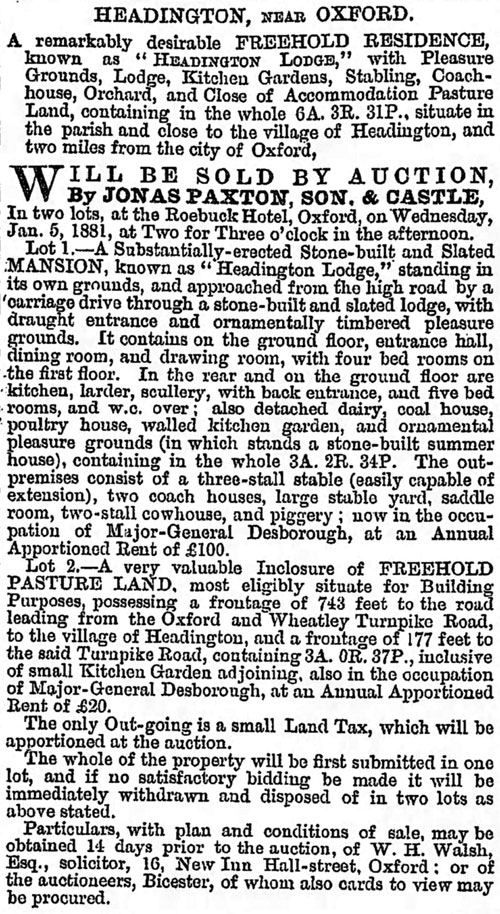
Colonel (later Major General) John Desborough rented Headington Lodge from 1877 to 1884 while he rebuilt The Priory, The mansion was owned jointly at this time by E. Graham Tylee, a gentleman of 14 Essex Street London, and Edward Tuckwell, a stockbroker of Throgmorton Street, London. While Major General Desborough lived there the freehold of the house (including the lodge on Osler Road, stabling, a coach house, and orchard, plus a kitchen garden on the north side of Cuckoo Lane) was put up for auction in one lot, and nearly seven acres of pasture land stretching right up to the London Road to the north in a second lot. The following advertisement appeared in Jackson's Oxford Journal on 18 December 1880:
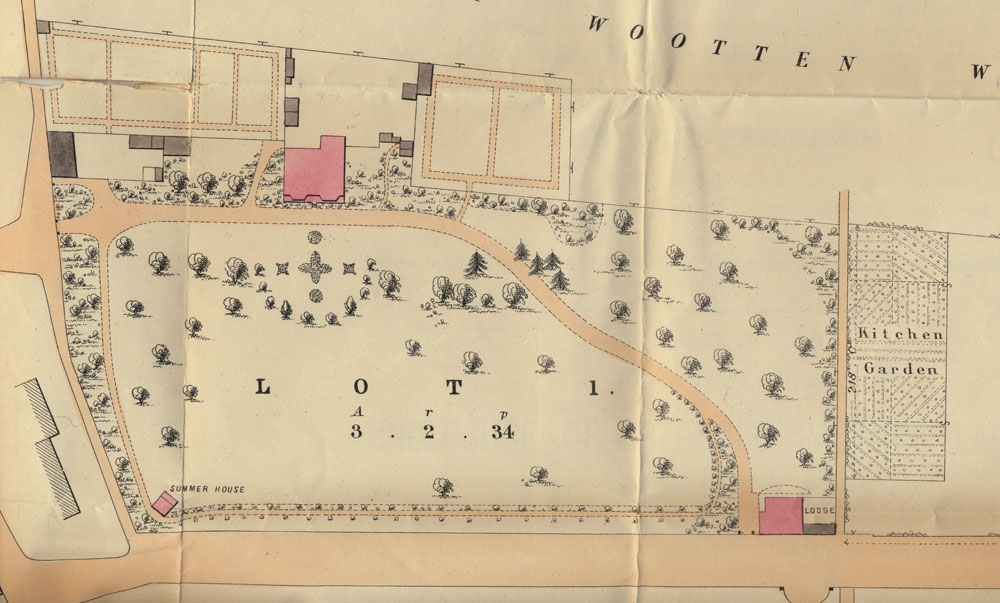
This plan below is from the sale catalogue shows the extent of Headington Lodge in 1880. North is left and South is right, so the road running along the bottom is Osler Road, and The Croft runs eastwards up the left-hand side. The large mansion in pink is Headington Lodge, and the smaller building on Osler Road shaded pink is its lodge. Its coach house on the Croft to the south (left) is shown in grey.
At the auction on 5 January 1881 Headington Lodge with its pleasure grounds, lodge, kitchen garden, stabling, coach house, and orchard was bought for £3,000 by William Wootten Wootten (formerly William Wootten Undershell), the Oxford banker who in c.1850 with his wife Sarah had moved into Headington House and was thus the immediate neighbour on the eastern side of Headington Lodge. (The doubling up of “Wootten” came about because the whole family, parents and nine children, changed their surname from Undershell to Wootten on 1 July 1867, and the family banking firm also changed its name from W. W. & J. Undershell to Wootten & Company at the same time.) Wootten-Wootten also purchased Lot 2 in the auction, namely the close of “accommodation pasture land” of over six acres running up from the mansion's kitchen garden to the London Road.
William Wootten Wootten and his family remained in Headington House and continued to let Headington Lodge out to its tenant, Major Desborough, who stayed there until around the beginning of 1884. .
Headington Lodge was advertised to let in Jackson's Oxford Journal on 1 March 1884, and it appears to have been taken by Lady Dilke. She did not stay long, however, as an advertisement on 17 October 1885 advertised her furniture for sale and stated that she was leaving.
The house was advertised to let again on 15 May 1886.
William Wootten Wootten died suddenly on 17 January 1887, and Headington Lodge was inherited by his widow Sarah, who continued to rent it out while living at Headington House, while their son Montague William Wootten Wootten (baptised Montague William Wootten Undershell at St Andrew's Church on 20 March 1853).took over his father's bank in Oxford. On 26 April 1888 at St Stephen's Church in Kensington Montague married Mary Sheard of 118 Cromwell Road, and his mother Sarah gave him Headington Lodge as a wedding present. Initially Montague remained in his home at Crossways, 143 Woodstock Road with his wife Mary.
Frederick Lavington Evans rented the house off Montague Wootten Wootten from 1887 to 1895, and Mrs Burch in 1896–7.
In about 1900 Montague William Wootten, who was a partner of Parsons, Thomson & Co. (Barclays) at the Old Bank in Oxford’s High Street, moved into Headington Lodge, which he had owned since 1888. At the time of the 1901 census, when this whole house (the present Sandy Lodge and White Lodge) was known as White Lodge, Montague (48) is listed here with his wife Mary Sheard and their three-year-old son Kenneth Savile Wootten: they were looked after by six indoor servants, plus their gardener who lived in the lodge.

Left: This postcard (reproduced by permission of Jeremy’s of Oxford) taken in the garden of White Lodge probably shows Montague and Sarah Wootten (towards the centre, with toddler Kenneth) and other family members in about 1900.
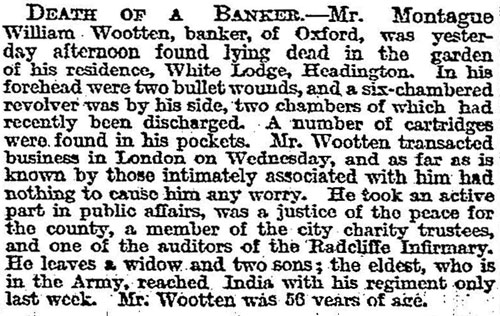
Eight years later, on 3 June 1909, Montague Wootten committed suicide in this same garden.
The report in The Times of 4 June 1909 (right) suggests that he had no worries.
On 5 June 1912 his executors put his Headington property up for sale by auction: as well as this large house, it included Headington House, Lower Farm, two detached houses with gardens, and a six-acre meadow. The sale catalogue is held in the Oxfordshire History Centre and two images can be seen online via PictureOxon:
It appears that the sale did not take place, as on 18 May 1912 the Evening Standard and St James's Gazette advertised another auction by direction of Montague Wootten Wootten's executors to be held at the Golden Cross Hotel on 5 June 1912 of all his Headington property, including White Lodge, which was described thus:
WHITE LODGE [including the present Sandy Lodge].—Charming Residence, containing hall, three reception rooms, conservatory, 12 bed and dressing rooms, bath-room; stabling for four horses; entrance lodge; gardens of nearly four acres.
From 1910 to 1914 White Lodge (still White Lodge and Sandy Lodge combined) was leased by a Mrs Newall or Newhall.
The next lessee, Miss MacGregor, founded Headington School in this house. It was opened by the Bishop of Liverpool in 1915 with ten boarders and eight day-girls. By 1918 the school had transferred to Brookside.
Division of Headington Lodge into two houses
In 1920 White Lodge was bought from Montague Wootten Wootten’s estate by Edwin J. Hall, who lived in Clifton House on the London Road and built the cinema in New High Street in his garden. He divided it into the two separate houses it is today:
- White Lodge on the right, with an entrance in Manor Road, later Osler Road
- Sandy Lodge on the left, with an entrance in The Croft
White Lodge, 42 Osler Road (formerly Manor Road)
White Lodge was purchased by Walter Smith in the early 1920s, and letters, drafts, and estimates concerning its purchase, plus a site plan and diagram of the building, is held in the New College Archives (NCA PA/SMA/12/2). He is listed there in directories from 1923 to 1935, and died there at the age of 80 on 5 March 1936.
White Lodge continued to be occupied by his widow, Mrs Katherine Spear Smith, and the 1939 Register shows her living here with her son Alic Halford Smith, then Fellow & Tutor of New College, Oxford. It was numbered for the first time around now, and its address was now 42 Manor Road.
Mrs Smith died in 1942, and in 1945 the house was listed as being occupied by her son, Alic Halford Smith, who was now Warden of New College. Its address was now 42 Manor Road. New College holds in its archive of his papers (NCA PA/SMA/12/3) photographs of White Lodge that were taken by Marjorie Paige Cox in 1937.
In 1945 it appears that Smith may have sold White Lodge to Thomas Pomfret Kilner, Nuffield Professor of Surgery and Fellow of St John's College, Oxford (letter from Kilner to Smith, New College archives NCA PA/SMA/5/5). In any event, Kilner is listed as living there from 1947 to 1956.
Alic Halford Smith died in 1958 at the age of 74. He never married, and after leaving his cottage at 86 Old High Street to W. J. Jennings (the porter at New College) and other small legacies including £500 to All Saints' Church, he gave the bulk of his estate to New College.
In 1958 White Lodge was occupied by Peter John de la Fosse Wiles, Fellow and Tutor in Economics at New College, who had moved temporarily out of Sandy Lodge.
The index to New College archives (NCA REG/D41/246) shows that in 1959 White Lodge was conveyed to Sir Isaiah Berlin for £8,000.
In 1959 Manor Road was renamed Osler Road.
In 1964 White Lodge was divided into two flats, one occupied by Alan Valentine and the other by Mrs Cameron (the married name of the novelist Elizabeth Bowen).
In 1967 the flats were occupied by Denis Mack Smith and B. Allen.
Sandy Lodge, The Croft
Sandy Lodge was initially let out to H. Raymond J. Holmes from 1923 to 1925.
Walter Hugh Hamersley lived here from 1929. The 1939 Register shows him as a retired land agent living at Sandy Lodge with his wife Gladys Theodosia Hamersley and his daughter Gladys Margaret Hamersley, who was running a kindergarten in a hut at Sandy Lodge. He died at the age of 75 and was buried in Headington Cemetery on 25 February 1941. Mrs Hamersley and her daughter remained at Sandy Lodge until 1952. By 1954 Miss Hamersley had moved to 22 Sandfield Road, but she continued to run her school at the hut in the grounds of Sandy Lodge into the 1960s. (Mrs Hamersley died in 1956, and her daughter in 1996.)
In 1954 Sandy Lodge in The Croft was occupied by Peter John de la Fosse Wiles, Fellow and Tutor in Economics at New College, and he was still there in 1956. There is no listing for the house in 1958 or 1960, then from 1962 to 1970 it was occupied by Mrs E. C. Wiles and was now numbered 7 The Croft. From 1972 it was occupied by Andrew D. Wiles.
(To confuse matters, from 1967 there was a second house in Osler Road also described as The Sandy Lodge that from 1967 was occupied by Gerald Bale.)
