


Brasenose Farm and Wood Farm
Brasenose Farm (originally owned by Brasenose College)
Brasenose Farmhouse is situated in Headington Quarry parish (opposite Aldi) and is now a kitchen shop. Both Horspath Driftway and Brasenose Driftway once led straight to it,, but since 1959 it has been cut off from the rest of Headington by the eastern bypass.
Along with the adjacent “Open Brasenose”, it was owned by Brasenose College, and in the nineteenth century it was often known as Bullingdon Green Farm.
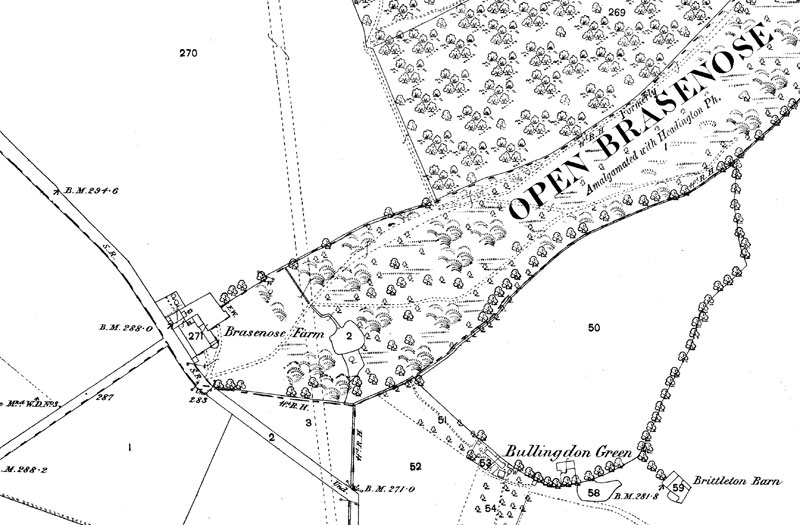 Map showing Brasenose Farm, Open Brasenose, and Bullingdon Green in 1881
Below: Brasenose Farmhouse in 1916
 Brasenose Farmhouse in 1998
 Outbuilding at Brasenose Farm, photographed on 28 November 2015
The lease of Brasenose Farm (described as enclosed and tithe-free) and 15 acres of the Open Brasenose were advertised for sale thus in Jackson's Oxford Journal on 22 August 1818:
All that capital LEASEHOLD FARM, most desirably situate about two miles from Oxford, adjoining to Bullingdon Green, in the parish of Headington, and in the occupation of Mr. Anthony Kimber, the proprietor; comprising a substantial tiled Dwelling House, barns, stables, and other convenient out-buildings, with 70 Acres of productive Inclosed LAND, in excellent cultivation, 20 Acres of which are Arable, and 50 of Wood Land.
Also a Right of Common of 15 Acres of Commonable Land, called Open Brazen Nose, adjoining to the home, with the whole of the Furze and Bushes growing thereon, forming altogether a most desirable retreat for any gentleman at a little expence.
The above Estate is held by lease under the Principal and Fellows of Brazen-Nose college for the term of 21 years, 18 of which were unexpired at Lady Day last.
At the time of the 1841 census Robert Hinde, or Hines, described as a bailiff, lived at “Bullingdon Green Farm” with his wife Mary and two young servants.
On 15 August 1846 a forthcoming auction of Bullingdon Green (Brasenose) Farm, to be viewed via appointment with Robert Hines on the farm, was advertised thus:
A FARM, close to Bullingdon Green, in the parish of Headington, Oxon, containing about 70 Acres of good ARABLE and wood land; and also valuable commonable rights, with dwelling house and homestead, &c., held by lease under Brasen-Nose College, Oxford, for 1 Years, from Lady-Day, 1842, at a rent of 30l. per annum.
The Headington Rate Book of 1850 lists Mrs Stockford as the owner of a house in Bullingdon Green, and Mr Kirby as the occupier. Its land measured 92 acres, and it had a gross estimated rental of £72 12s. and a rateable value of £66. The 1851 census confirms that Alexander Kirby (30) was then the farmer at “Bullingdon Green Farm”: he was described as a “farmer of 110 acres, employing four men”. Kirby is also listed as the farmer here in Gardner’s Directory of Oxfordshire of 1852, but in Lascelle’s Directory of 1853 the entry changes to Mrs Ann Kirby, who died in 1857.
At the time of the 1861 census, the agricultural labourer Robert Bowell lived at Brasenose Farm with his wife and two children. He was still living there in 1871, when he was described as a “Farm Servant, Indoor (in charge)”, with his wife and daughter.
In the 1860s Brasenose Farm appears to have been farmed by John Hurst of Temple Cowley: an advertisement in Jackson’s Oxford Journal on 28 March 1868 stated that the sale of the farming stock of Hurst following his death was to take place “at the Brasenose Farm premises”.
By 1873 Brasenose Farm was rented by a Mr Hurman. Jackson’s Oxford Journal of 28 June 1873 reported the following case at Bullingdon Petty Sessions:
George Webb, of Headington Quarry, labourer, was charged with being in search of conies, in the day-time, in Brasenose Wood, on the 15th instant. Wm. Windows, a gamekeeper, in the employ of Mr. Hurman, stated that his master rented the farm from Brasenose College, and the land in question was that known as “Open Brasenose,” which was about thirty acres in extent, and open at one end. He saw defendant, with two other men, at half-past six in the morning of the above-named day, with two dogs and sticks, beating about among the bushes. Witness told defendant that he was doing wrong, but he made no reply. Mr. Hurman had never prosecuted any one before for trespassing, and there had been a good deal of dispute about Brasenose Wood. Webb, in defence, denied having a stick in his hand. The Magistrates considered that the case had not been sufficiently proved, and therefore dismissed it.
At the time of the 1881 census Robert Bowell, a widower of 66 described as a farm labourer, was living at “Brasenose Farm” together with another farm labourer, William Dennis (31) and his wife and four children.
By 1883 Brasenose Farm was held by John Chillingworth of Cuddesdon (who at the time of the 1881 census was living at the Manor Farm House, Cuddesdon and recorded as farming 350 acres and employing 18 men and three boys). His keeper, Frederick Surman, was now living at Brasenose Farm. Jackson’s Oxford Journal of 14 July 1883 reported thus on the summer assizes:
William Cross, 21, labourer, of Cowley (on bail) was indicted for setting fire to certain gorse and furze at Headington, on the 5th of May, on land in the occupation of John Chillingworth, of Cuddesdon, and the property of the Principal and Fellows of Brasenose College…. Frederick Surman, keeper to Mr. Chillingworth, who occupies Brasenose Farm, at Headington, said on the 5th of May he was on a part of the farm called Open Brasenose, where there were growing gorse and 3000 tied up fagots. The place was a sort of enclosed common, and it adjoined Brasenose Wood.
By 1891 Brasenose Farm was rented from Brasenose College by Richard Pether, who had been renting Wood Farm from Magdalen College since 1850. When in 1881 his son-in-law Frederick Morris returned to Headington from Worcester with his wife Emily and their first child William Richard Morris (the future Lord Nuffield). Pether made him his farm bailiff. The 1891 census lists Brasenose Farmhouse as being unoccupied, and shows the Morrises living at “Brasenose Lane” in Headington Quarry parish, presumably in an adjacent building.
By 1899 Abel Bricknell of Headington was the tenant of Brasenose Farm, and is named in a report in Jackson’s Oxford Journal of 26 August that year about the successful prosecution by Brasenose College at Bullingdon Petty Sessions of three young men who had been poaching on the farm’s land. He is duly listed as a Quarry farmer in Kelly’s Directory of 1900, but by the time of the 1901 census George Bricknell (29) was the Farm Bailiff living at Brasenose Farm with his wife and young son: Kelly’s Directory lists him as a Quarry farmer from 1902 to 1904.
At the time of the 1911 census “Brazenose Farm” was occupied by the illiterate shepherd Edwin Colwell (52) and his wife and two children.
The 1921 census shows Richard Maskell (50), described as a farmer, living at Brasenose Farmhouse with his wife May (40).
Kelly's Directory from 1938 lists “ Ballard Jas. Philip (Brasenose farm)” as a private resident under Horspath Driftway.
Brasenose Farmhouse is now owned by Oxford City Council, and a planning application was approved in June in 2016 to convert the farm buildings: 15/01247/CT3. Brasenose Farmhouse is now a kitchen shop.
 Some of the farm land is now allotments, photographed on 28 November 2015.
The path was known as Brasenose Lane in the nineteenth century.
Wood Farm (originally owned by Magdalen College)
The Headington Enclosure Award of 1804 refers to a farm house near the Slade belonging to Magdalen College which is obviously Wood Farm. It was then held under the college by John Townesend, who had inherited it from his brother Stephen in 1800.
In the 1841 census, the farmhouse at Wood Farm was occupied by the agricultural labourer William Saunders (55) and his wife and six children.
By 1851 Richard Pether left his brother Henry to farm Bartlemas Farm on his own and had taken on the lease of Wood Farm, coming to live within the boundary of the newly-established parish of Holy Trinity Church in Headington Quarry. His farm increased in size over the years, partly because he encroached on Open Magdalen.
Wood Farm |
||
Document |
Acreage |
Other information given |
1850 rate book |
164 acres 2 roods |
Gross estimated
rental: £138-5-0 |
1851 census |
200 acres |
17 men employed by Pether |
1861 census |
207 acres |
12 men and 11 boys employed by Pether |
1871 census |
295 acres |
9 labourers, 5 women, and 5 boys |
1881 census |
370 acres |
17 men, 3 women, and 6 boys |
 Map of Wood Farm in 1878, showing part of Open Magdalen to the south east
In the early 1890s, when he was nearly 80, Richard Pether left Wood Farm and retired to Old Headington. Thomas William White (born 1868) had been leased the sporting rights of Open Magdalen in 1892 and is first listed as the farmer at Wood Farm in Valter's Directory of 1894. The 1921 census shows White (53) living at Wood Farm with his wife Alice (47), his son Edward (18), who assisted his father in general farm work, and his daughters Lilian Evelyn Vallance White (23) and Josephine Selina White (2).
In April 1934 (during the time that the farm was held by the Whites), Magdalen College sold the whole of the Wood Farm estate including Open Magdalen to Lord Nuffield for £26,000.
The 1939 shows Thomas William White and his wife Alice living at Wood Farm with their children Lilian, Richard, and Doreen.
Thomas William White was still the yearly tenant who farmed Wood Farm in the 1940s, when it was known as White’s Farm. On 25 February 1944 there was a requisition order for land at Wood Farm for a Ministry of Works Labour camp, and White was compensated. He died aged 80 in 1948.
From 1949 his widow Mrs Alice M. White (aka Mrs T. White) is listed as the farmer at Wood Farm (under The Slade). Two “White's Cottages" were still listed there then. In 1951 the city council started to build the Wood Farm council estate on some of the land. She died at the age of 83 near the end of 1957.
From 1958 the farmer at the much smaller farm was her son Richard Cyril White, who in 1970 was still listed as living in the farmhouse as the farmer. In 1971 the house was unoccupied, and it was probably demolished at the end of that year or in early 1972.
