


Barton End (now Beechwood House), 10 Barton Road
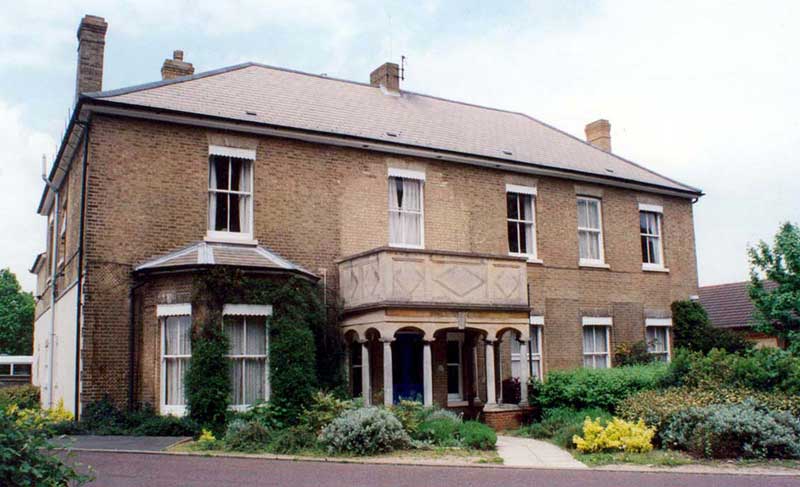
Above: Beechwood House (formerly Barton End) in 2005
Below: The same building in 2021 showing new flats with dormer windows in the roof
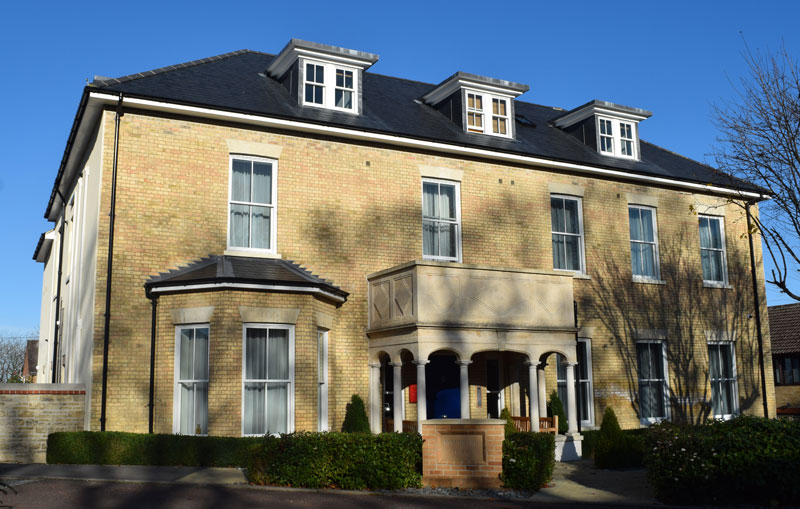
Barton End was built in the early 1880s as a private house. Its grounds once extended to the recreation ground to the south, and it was for many years an old people’s home called Beechwood House,.
The Ordnance Survey map of Headington in 1899 (below) shows that at the end of the nineteenth century Barton End (to the right of centre) was still the only building in Barton Road, which was a route through the countryside from Headington Quarry to the hamlet of Barton. There was, of course, no bypass then, so that Barton Road led seamlessly into the present Barton Village Road after being joined from the west by Barton Lane coming from Old Headington.
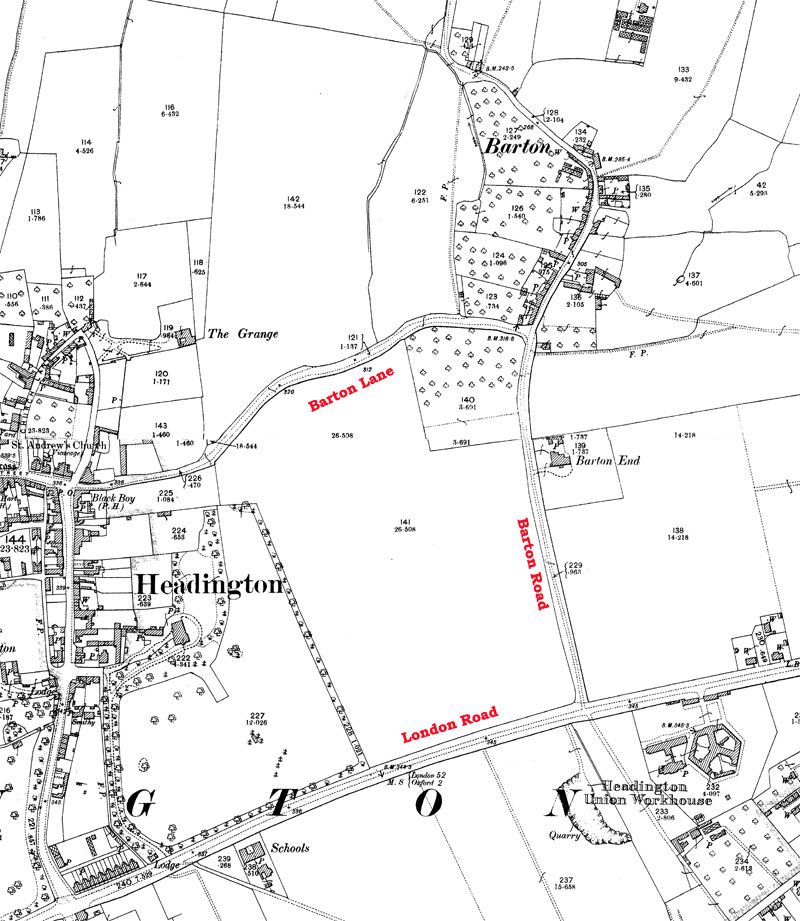
The site of Barton End
William Orchard, the master mason responsible for much of Magdalen College’s building work in the fifteenth century, lived in Magdalen property at Barton that was described as “a lyttel house with an orchard called the Pale and three acres of land”. This is believed to have stood on or near the site of the present Barton End. As the above 1899 map shows, there was an old path from Quarry leading straight up to Barton Road, and it would have continued without interruption to Barton before the London Road was created in the late eighteenth century.
Barton End: A private mansion, c.1880–1952
Barton End was built by Major-General Arthur Harness for his father General Sir Henry Drury Harness and his unmarried sister Caroline Mary Harness. Sir Henry had retired in October 1878, and he moved into Barton End with Caroline (known as “Coe”) probably to be near the family of his only married child Mary, who was married to Daniel Harper, who since 1877 had been Principal of Jesus College, Oxford. General Harness died suddenly at this house on 10 February 1883 at the age of 78, and was buried in St Andrew’s churchyard in Old Headington four days later. Caroline immediately went to live with her brother Arthur at Woolwich, where he was Captain of the Cadet Company at the Royal Military Academy.
The Harness family then let Barton End out to tenants. On 24 March 1883 the following advertisement appeared in Jackson's Oxford Journal:
TO be LET (UNFURNISHED)—“BARTON END," Headington, a large and well-built Country Residence, with large Garden, Tennis Ground, &c.
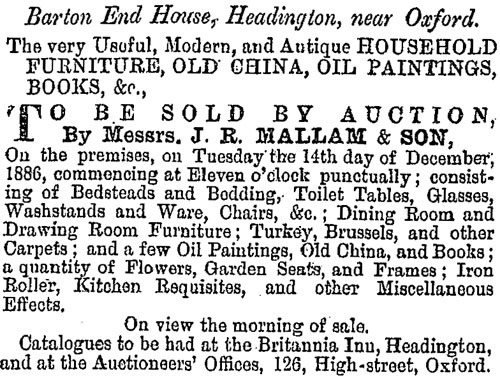
The first tenant listed in Kelly’s Directory was Mrs Sarah Peace Evans in 1884. She died at this house on 19 March 1886, and her death notice in Jackson's Oxford Journal stated that she was the widow of Thomas Moore Evans, late of Warsaw. On 8 May 1886 Mallam’s advertised it to be let unfurnished (changed to “partially furnished” on 12 June). On 30 October 1886 the house was still unlet, and shortly afterwards the rest of the contents were evidently sold, as the following advertisement appeared on 4 December 1886:
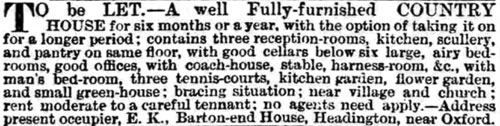
In 1887 the house was occupied by another widow, Mrs Henry Kennedy. Her daughter Lizzie Harriet Kennedy married Hugh Stephen Thompson at St Andrew's Church on 16 April that year. On 23 June 1888 the following advertisement advertising that Barton End House was to let appeared in the Morning Post:
By 22 March 1890 Mrs Kennedy had moved out, as there was another furniture sale advertised on that day:

By the time of the 1891 census the house was occupied by the florist Charles Jacob, his wife Ellen, and son Jacob.
There were then three very short-term occupants of Barton End:
- The Revd. Charles T. Gillett, listed there only in the 1893 directory
- H. Stafford T. Bisco , listed in 1894 and 1895
- Harriet Binning-Monro, the widow of Alexander Binning-Monro, was listed here in 1898, but died at Barton End at the age of 81 on 7 March that year. .
The Revd Henry Spencer Kenrick Bellairs, University Reader of Marathi and a clerk in holy orders (despite only achieving a Fourth in Law & Modern History in 1863 after studying at Pembroke College, Oxford) was the next occupant, and can be found in the house in the 1901 census, aged 60, with his wife, his three daughters aged 23, 26, and 27, and two servants. He continued to be listed at Barton End in directories to 1907, but on 3 August that year he took his life there.
From 1909 to 1919 the house was occupied Ada Louisa Way (Mrs Gregory Way). The 1911 census shows her at the age of 58, and stated that she was the head of the household but had been married for 22 years. She was childless, and lived at Barton End with three servants.
The development of Barton Road started in 1920, when the council houses built by Headington Rural District Council on the London Road turned the corner into this street.
From 1921 to 1923 Barton End was occupied by Major Richard Rouse Sydenham Rowell (the son of the Oxford jeweller Richard Sydenham Rowell and his second wife Catherine Eliza Sedgley). At the time of that year's census only the butler & cook (Alfred & Ethel Holley) were at home in Barton End and Rowell (39) was staying at a hotel in Thanet: aged 39, he described himself as a director of companies in Oxford.
The next owner was Horace Joseph Bradley, JP, who lived in the house from c.1925. He was a well-known businessman in Oxford, owning the Cadena Café, Weeks' Bakery, and the George Restaurant, and donated the land of the former nursery opposite Barton End to be used as an amateur sports ground by Headington cricket club, which was being squeezed out of the Manor Ground by Headington United Football Club (of which he had been a director) and planning permission was granted in October 1951 (51/02051/A_H). Bradley died at Barton End in 1945 at the age of 77 and his son Horace Fred Bradley was listed at Barton End in Kelly's Directory until 1952.
Barton End (renamed Beechwood House), 1952–present
In March 1952 planning permission was granted for change of use of Barton End to an old people's home (52/02295/A_H). The mansion was duly taken over by Oxford City Council Welfare Services Committee as “Part III accommodation” for elderly people. Dormitory and dining extensions were approved in 1955 (55/04192/A_H).
In about the 1980s Barton End was renamed Beechwood House.
In 1990 two major developments relating to this house and its extensive garden were approved:
- Thirty sheltered apartments and a warden's flat were built on the land to the south of the garden (89/00834/NF)
These are called The Sycamores - Barton House itself was converted to five flats, and 25 houses were built in
its garden (91/01390/DF)
An additional two flats in the loft of the main house were approved in 2017 (16/02508/FUL)
The flats in the original house are numbered 1–7 Beechwood House, while the 25 houses are in a new access road off Barton Road are called The Beeches.
In 2016 planning permission (16/02508/FUL) was granted for a loft conversion to provide two more flats, and in November 2021 the former mansion, which now comprised seven flats, was advertised for sale with a guide price of £4,800,000.
In 2016 thirty houses in a development named “The Willows” were built on the cricket ground in Barton Road that had been donated by Horace Bradley.
